
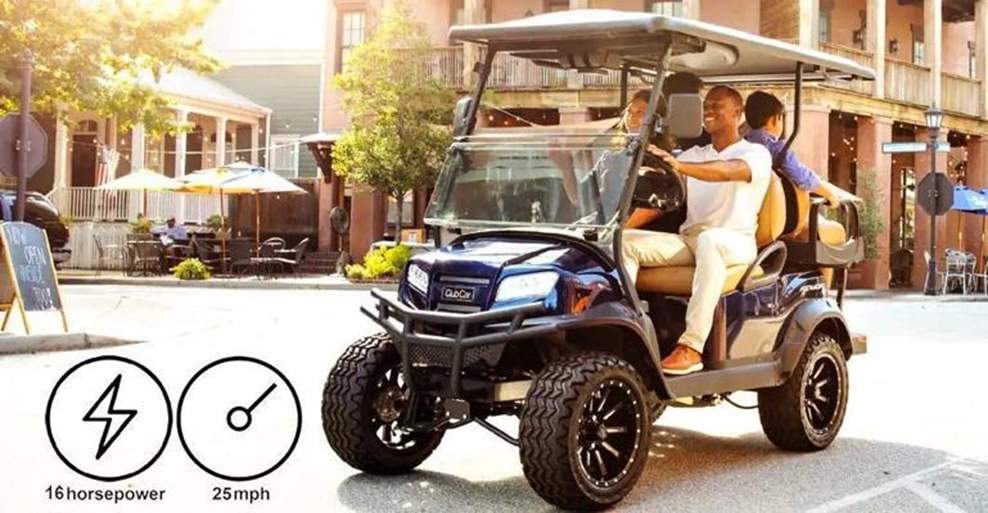
A golf cart and a street-legal vehicle can look very similar, but there are important differences between the two. Vehicles designed for use on a public road (rather than just the golf course or a planned community that allows golf carts.) must meet specific federal safety and performance requirements, while state and local laws determine where they can actually be driven.
This distinction becomes particularly important when comparing personal transportation vehicles (PTVs) with Low Speed Vehicles (LSVs). PTVs are commonly used for short trips within approved neighborhoods and residential communities. LSVs, on the other hand, are legal to drive on most roads with posted speed limits under 35MPH
So, what makes a vehicle street legal? It all comes down to its classification, equipment and the particular rules that apply wherever you plan to drive.
The difference is not just cosmetic
PTVs and street-legal vehicles may share the same compact design, but they are built with different environments in mind. A vehicle intended for use on public roads needs to meet requirements that go beyond those associated with everyday neighborhood travel.
Speed and vehicle classification are part of the distinction, but so are features designed for an on-road environment, including occupant protection and visibility.
What changes when you travel beyond the neighborhood?
A PTV is well suited for short, local journeys within a community setting. You might use one to get to the pool, call in to see a friend, or travel from one part of the development to another.
Trips beyond the neighborhood are different. If the route involves public roads, a street-legal vehicle may be required. LSVs are built for this kind of journey, with the relevant safety equipment, speed range, and vehicle classification already taken into account.
PTV or LSV: which is which?
The simplest distinction is one of purpose. PTVs are commonly used for short, local trips. Low Speed Vehicles (LSVs), by contrast, are manufactured to meet a specific federal vehicle definition for limited use on public roads.
To fall within the federal LSV category, a vehicle must have four wheels and be capable of traveling faster than 20 mph but no faster than 25 mph. It must also have a gross vehicle weight rating (GVWR) of less than 3,000 pounds.
More than lights and mirrors
A street-legal vehicle needs a substantial set of safety features. Under federal rules, these include:
- road lighting and turn signals
- mirrors and reflectors
- seat belts
- a compliant windshield
- a parking brake
- Roll over protection
- Back up camera
- AVAS system
- a VIN
Taken together, these requirements reflect the fact that an LSV is intended for an on-road environment. Its visibility, occupant protection, and other safety features form part of a vehicle that has been designed as a complete system for this type of travel.
State and local rules still need to be checked. Meeting the federal definition does not mean an LSV can automatically be driven on every public road, so buyers should always seek out the regulations that apply where they live.
Built for the road from the start
When choosing a street-legal vehicle, look for one that has been designed with on-road safety and performance in mind from the outset. Purpose-built vehicles are engineered as complete systems, with features such as occupant protection, visibility, and handling designed to work together.
Among the purpose-built options available, Club Car’s street-legal vehicles are designed for journeys that extend beyond the neighborhood and onto permitted public roads. Buyers should still compare the specifications of any LSV with their state and local regulations before deciding which vehicle best suits their needs.
“Street legal” does not mean that a vehicle can go anywhere. It means that the vehicle meets a particular set of requirements, while state and local laws determine where it can actually be driven. Checking those rules before buying can save a great deal of inconvenience later – and help you choose a vehicle that fits the journeys you actually plan to make.
