
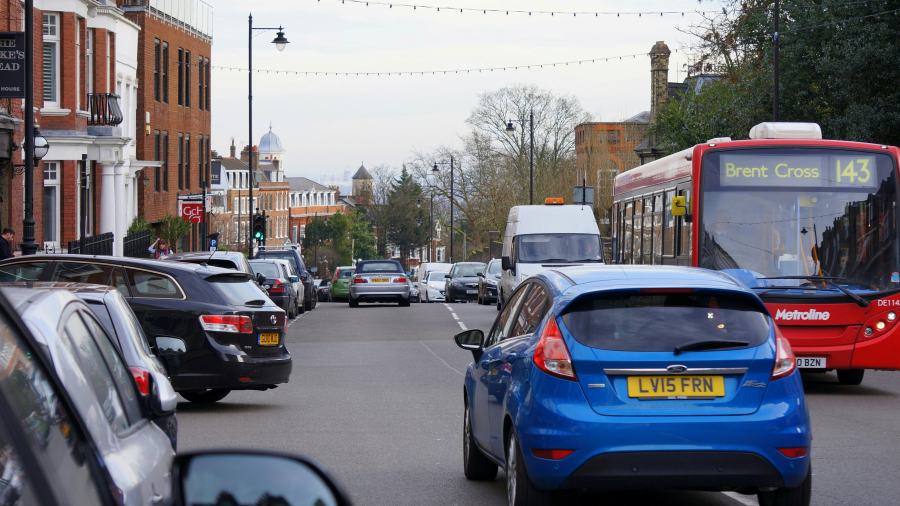
You notice traffic the same way you notice bad weather – when it puts a damper on your day. And if you drive in either Michigan or Tennessee, you already know that congestion is something you need to deal with on a daily basis.
But, not for the same reasons, which is where both states come into play.
Michigan can have some bad winters, and as soon as there’s a bit of snow on the road, it’s not uncommon to see a 10-mile-long traffic jam. Tennessee doesn’t have that problem, but where traffic problems happen in this state is on the interstate highway, and how the highway’s merging/converging junctions create mile-long congestions, especially during the summer tourism season or when there are major events (concerts, leaf-peeping season, etc.).
The reason why we picked these two states as examples is that both have an increasing volume of traffic each year, but they have different pressure points and different ways to deal with those.
Comparing MI and TN won’t just show WHERE the jams happen but also WHY they happen in the first place.
Road Layouts and How They Affect Traffic
Michigan’s road network grew and expanded around big manufacturing centers; if you drive there for a while, you get to feel that right away.
The roads are very easy to follow, and you’ll see a lot of frontage roads. These give you extra ways to enter or exit busy stretches, so that not everyone has to go into the same choke points.
Things are totally different in Tennessee.
There are bends, climbs, drops… It all follows the hills, naturally, and those elevations change how traffic behaves. You get tight curves and lanes that open and close faster than you’d expect.
Obviously, that alone is more than enough to create bottlenecks, but when you add multiple major interstates meeting in big cities such as Memphis or Nashville, you get why congestion builds so quickly.
And because you’ll see those interstate congestions often in cities like Nashville, it’s not uncommon to see lots of crashes. Sure, they might not be major, but you can surely bet they’ll cause a massive jam. Lots of people who find themselves in such a pickle will look up a lawyer to get guidance for navigating a Nashville car crash.
If you’ve ever found yourself in a massive traffic jam, then you know how slow driving and frequent stopping cause people to get nervous and/or frustrated. And this indirectly causes the accidents to happen.
Basically, Michigan’s wider lanes and flatter terrain give you way more room to move, whereas Tennessee’s roads make every merge feel heavier.
Technology & Traffic Congestion Managing Strategies
Add a lane here, a lane there, a bridge, and you’re done.
Well, not quite (sadly).
It takes a lot more to keep traffic moving, and you can’t exactly use one blueprint to solve the problem, because each city will have traffic congestion issues based on different factors:
- Population (density)
- Road network
- Urban layout
- Public transit (availability/usage)
- Traffic signals
- Construction zones/deliveries
- accidents/incidents
- Parking availability
- Weather conditions
- Tourism
And these aren’t all factors, but they are the main ones. And for two states, or cities, to have all those factors at the same value is not realistic. Each place has its own unique formula for why traffic congests, and there’s a unique way to solve it.
Here are the Michigan and Tennessee examples to demonstrate:
Michigan
In Michigan, you see smart signals that adjust timing based on how the traffic flows, and they use freeway sensors that track changes in speed and detect sudden slowdowns. You’ll also see connected-vehicle corridors that test communication systems between cars and the infrastructure.
A lot of these tools come from pilot programs built through partnerships with car manufacturers and research institutions, so Michigan is a testing area for the new technology.
While ‘new tech’ sounds exciting and fancy, the goal is really simple – keep traffic going through the busiest times and spot problems so you can deal with them before they cause chaos (e.g., huge traffic congestions).
Tennessee
Tennessee takes a different approach compared to Michigan, where they fully focus is on real-time updates with TDOT’s SmartWay system (cameras, digital message boards, constant monitoring, etc.), which provides drivers with quick information, such as crashes, lane closures, sudden slowdowns, potential shutdowns, and anything similar that may affect their choices on the road.
Tennessee’s interstates are full of sharp curves and steep hills, which means that if you decide to (or are forced to) make a single unexpected stop anywhere, you could cause a dangerous situation for yourself and everyone around you – and we’d like to avoid that, if possible.
How Both States Use Traffic Data
One word – ‘data’.
Data is the prime ingredient in all technology and in decision-making when it comes to pretty much any traffic system anywhere in the world, and MI and TN are not exceptions to the rule.
Traffic counts show which roads have the heaviest loads. Crash data shows where drivers are most likely to make mistakes. Capacity studies help planners know which stretches are close to their limits.
All of this info feeds into decisions about retiming signals, redesigning intersections, upgrading ramps, improving entire corridors so that the flow of traffic is improved in the long run, etc., etc.
The more real-time, accurate data you have, the better systems you can build because you can quickly identify pain points and then enforce more effective strategies than you’d otherwise be able to do.
Conclusion
If we were to summarize the entire article into two words, it’d be: ‘chaotic traffic’.
And the thing is, you can’t just ‘get used to it’ and be done with it. That’s because lots of different places handle traffic congestion differently. So if you feel comfortable driving in one city, you might not do so in another – both Tennessee and Michigan are great examples we’ve used to show that.
It all comes down to this – tweaking and experimenting. And one day, perhaps, we’ll hit that sweet spot where everyone keeps moving (safely) at all times.
But it’s two different kinds of chaos. Both Tennessee and Michigan prove one thing, though, and that’s that no matter how many lanes you add or how many sensors you plug in, no two places handle congestion the same.
It all comes down to tweaking and experimenting all the time so that, one day, you can hit that sweet spot where everyone keeps moving at all times.
